


Preserving Wealth Through Retirement Starts Here
When your retirement portfolio grows to seven figures or eight figures, the way you think about the future begins to shift. It's no longer about whether you'll have enough. It’s about how to intentionally preserve what you've built, avoid costly missteps, and align your wealth with your future vision.
This is more than just financial. It’s personal. It’s not only your capital that’s at stake. It’s also your time, your impact, and your legacy.
This article explores four key strategies to help protect, extend, and align your wealth through retirement:
The visual framework below can help you reflect on how your goals evolve, from near-term needs to long-term impact.
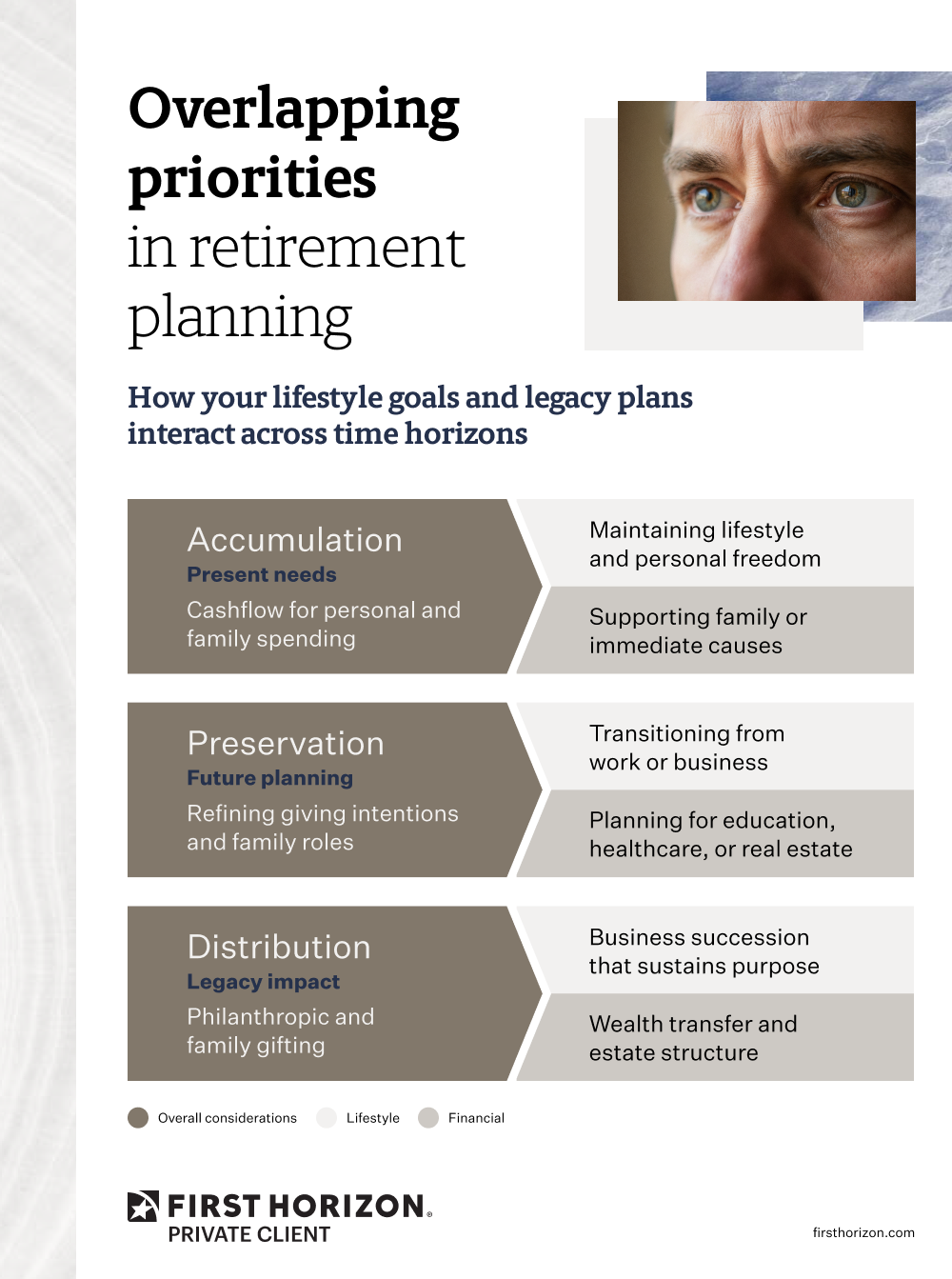
Overlapping Priorities in Retirement Planning
Your lifestyle goals and legacy plans evolve across time – from immediate needs to long-term impact. This visual helps illustrate how short-term decisions, mid-term planning, and enduring values often overlap, requiring an integrated strategy.
Beyond Growth: Understanding the Preservation Imperative
For wealthy individuals, retirement isn’t simply exiting the workforce. It’s entering a new phase of strategic wealth stewardship.
What is Wealth Preservation? Wealth preservation means protecting accumulated assets from avoidable losses, unnecessary taxation, inflation erosion, and emotionally driven decisions, all while aligning with long-term purpose.
Key mindset shifts may include:
- From Growth to Guardrails: Prioritizing stability over aggressive returns.
- From Risk-Taking to Risk-Awareness: Weighing protection as carefully as performance.
- From Accumulation to Allocation: Designing your wealth to support your values, legacy, and liquidity needs.
How does retirement planning change for wealthy individuals? It becomes about designing a life that reflects your values, not just your net worth.
Strategic Withdrawal: Minimizing Tax Impact on Your Wealth
Taxes are one of the largest erosive forces in retirement – and high-net-worth individuals often encounter the most complex implications.
Here are four tax-smart withdrawal approaches to explore with your team of financial professionals:
- Asset Location Strategy: Understanding the potential benefits of coordinating withdrawals from different account types (traditional IRAs, taxable accounts, and Roth IRAs) may help manage lifetime tax exposure.
- Tax Bracket Management: Being aware of tax bracket thresholds and how Required Minimum Distributions (RMDs) might affect your tax situation can be an important planning consideration. For example, married couples filing jointly may want to recognize income up to the $394,600 threshold for the 24% bracket (2025 figures) before higher rates take effect through RMDs1.
- Roth Conversion Laddering: Evaluating whether to convert portions of tax-deferred assets to Roth accounts based on your current and future tax situation.
- Tax-Advantaged Investing:2 Understanding how certain investments may offer tax advantages based on your specific situation.
These educational concepts should be discussed with your team of financial professionals to determine what might be appropriate for your unique circumstances.
1 2025 Federal Income Tax Brackets: According to the IRS, for the tax year 2025, married couples filing jointly fall into the 24% tax bracket if their taxable income is over $206,700 up to $394,600.
Required Minimum Distributions (RMDs): The IRS mandates that individuals begin taking RMDs from their retirement accounts starting at age 73. These distributions are included in taxable income and can potentially push individuals into higher tax brackets.
https://www.irs.gov/retirement-plans/retirement-plan-and-ira-required-minimum-distributions-faqs
2 Available through LPL
Protecting Your Lifestyle: Advanced Risk Mitigation Approaches
Even with significant wealth, risk doesn’t disappear. It evolves. And the stakes rise.
Scenarios to safeguard against:
- Sequence of Returns Risk: A 15% loss on a $5M portfolio early in retirement can permanently impair cash flow. Coordinating withdrawals and smoothing income becomes critical.
- Inflation Protection: Hedging with assets like TIPS, equities, or real estate helps maintain purchasing power over decades.
- Healthcare & Long-Term Care Planning: Developing strategies to address potential care needs in later life. For example, HSAs, cash reserve planning, etc.
- Liability Shielding: Insulating personal assets from lawsuits or claims through proper use of umbrella insurance, trust titling, and legal structures.
- Legacy Coordination: Aligning retirement and estate strategies.
Preservation isn’t just about protecting. It’s about preparing.
Strategies to integrate:
- Beneficiary Designations: Keep them aligned with your estate intentions, not just your account paperwork.
- Trust Structures: From revocable living trusts to irrevocable gifting vehicles, structure matters when managing multigenerational wealth.
- Generation-Skipping Transfers: With annual exclusion gifts set at $19,000/person (2025)3, there are opportunities to fund grandchild education or other causes now.
- Philanthropic Planning: Aligning your giving strategy with your personal values and purpose can create meaningful impact while potentially offering tax advantages.
For more, visit our Trust Services or Financial Planning pages.
3 IRS, "What's new – Estate and gift tax," https://www.irs.gov/businesses/small-businesses-self-employed/whats-new-estate-and-gift-tax
What Comes Next: A Retirement That Reflects You
Preserving wealth through retirement is about more than maintaining your financial footing. It’s about ensuring your resources stay aligned with your values, your family, and your future.
True confidence in retirement comes not from predicting outcomes, but from knowing you have a strategy that adapts to them.
